















Mass Readings
Catholic Ireland
Liturgical Readings for : Friday, 5th June, 2026Léachtaí Gaeilge
Next Sunday's Readings
Friday of the Ninth Week in Ordinary Time, Year 2
Saint of the Day: 5 June; St Boniface , bishop and martyr
C/f A short life of be this saint can be found below todays’ Readings and Reflection.
READING
A reading from the first letter of St Paul to Timothy 3: 10-17
Anybody who tries to live in devotion to Christ is certain to be attacked.
 You know, though, what I have taught, how I have lived, what I have aimed at; you know my faith, my patience and my love; my constancy and the persecutions and hardships that came to me in places like Antioch, Iconium and Lystra – all the persecutions I have endured; and the Lord has rescued me from every one of them. You are well aware, then, that anybody who tries to live in devotion to Christ is certain to be attacked; while these wicked impostors will go from bad to worse, deceiving others and deceived themselves.
You must keep to what you have been taught and know to be true; remember who your teachers were, and how, ever since you were a child, you have known the holy scriptures – from these you can learn the wisdom that leads to salvation through faith in Christ Jesus. All scripture is inspired by God and can profitably be used for teaching, for refuting error, for guiding people’s lives and teaching them to be holy. This is how the man who is dedicated to God becomes fully equipped and ready for any good work.
The Word of the Lord Thanks be to God
Responsorial Psalm Ps 118; 157, 160, 161, 165, 168
Response The lovers of your law have great peace.
1. Though my foes and oppressors are countless I have not swerved from your will.
Your word is founded on truth: your decrees are eternal. Response
2. Though princes oppress me without cause I stand in awe of your word.
The lovers of your law have great peace; they never stumble. Response
3. I await your saving help, a Lord, I fulfil your commands.
I obey your precepts and your will; all that I do is before you. Response
Gospel Acclamation Ps 18: 9
Alleluia, alleluia!
Your words gladden the heart, O Lord, they give light to the eyes.
Alleluia!
Or Jn 14: 23
Alleluia, alleluia!
If anyone loves me he will keep my word,
and my Father will love him, and we shall come to him.
Alleluia!
GOSPEL
A reading from the Gospel according to Mark 12: 35-37
The Lord said to my Lord: Sit at my right hand.
 While teaching in the Temple, Jesus said,
‘How can the scribes maintain that the Christ is the son of David? David himself, moved by the Holy Spirit, said:
The Lord said to my Lord: Sit at my right hand and I will put your enemies under your feet.
David himself calls him Lord, in what way then can he be his son?‘ And the great majority of the people heard this with delight.
The Gospel of the Lord Praise to you Lord Jesus Christ
********************
Gospel Reflection Friday, Ninth Week in Ordinary Time Mark 12:35-37
In today’s first reading Saint Paul reminds Timothy of the value of the Scriptures, how they can teach us the wisdom that leads to salvation because they are inspired by God, how they can guide our lives. When Paul speaks of the Scriptures there, he is of course referring to what we call the Old Testament, the Jewish Scriptures, because at that time there was no New Testament, no Christian books that had become canonical or authoritative.
The first believers greatly valued the Jewish Scriptures; they were the only Scriptures they had. In this, they were following in the path of Jesus who himself was steeped in the Jewish Scriptures. In the gospel reading, Jesus quotes from one of the psalms to show that the Messiah is more than the Son of David; he is also David’s Lord. Because Jesus and his first followers valued the Jewish Scriptures so much, the church ever since has valued them. That is why the first reading on Sunday and even on weekday is regularly drawn from the Jewish Scriptures.
They may not speak to us as powerfully at times as they spoke to Jesus and his first followers, because they are further from us in time and in culture. Yet as Christians we venerate them because, like Jesus and the early church, we recognize that there is a great wisdom there, in the words of our first reading, ‘the wisdom that leads to salvation’.
The scripture readings are taken from The Jerusalem Bible, published by Darton, Longman and Todd Ltd and used with the permission of the publishers. http://dltbooks.com/The Gospel reflection comes from WEEKDAY REFLECTIONS 2019-20: The Word of God is Living and Active by Martin Hogan and published by Messenger Publications c/f https://www.messenger.ie/product/the-word-of-god-is-living-and-active-reflections-on-the-weekday-readings-for-the-liturgical-year-c/f www.messenger.ie/bookshop/
________________________
Saint of the Day: 5 June; St Boniface , bishop and martyr
Boniface was born in Devon (England) about 675; died in the Netherlands on this day in 754. A monk and teacher who went to evangelise the Germanic peoples. He was ordained bishop and given wide-ranging papal commissions throughout Germany and Gaul. He founded monasteries and established dioceses, presided at synods, and maintained close associations with various emperors. He was honoured as a determined missionary and as a Church organiser and reformer whose work shaped the future of Europe. He is buried at his abbey of Fulda (near Frankfurt).
Patrick Duffy tells his story.
Early life as a monk
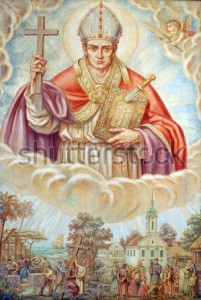 Born and baptised Winfrid about 673 in Crediton, Devon, England, and educated at Exeter, he entered the Benedictine abbey at Nursling near Southampton. As a monk he studied, expounded the Bible and compiled the first Latin grammar written in England. He went to preach the gospel in Holland, Germany and France where he had significant influence in establishing the Church.
First mission to the Frisians
In 716 Winfrid went on a mission to the Frisians (the Dutch), where the language was similar to his own Anglo-Saxon, but war between King Charles Martel of the Franks and King Radbod of the Frisians forced him to return to Nursling.
Commissioned by Pope Gregory II
In 718 he went to Rome where Pope Gregory II (715-731) commissioned him to preach the gospel and organise the Church in Germany and latinised his name to Boniface.
Expansion of his mission in north Germany
The Church in Germany had lapsed into paganism and Boniface worked here for a short time until death of the Frisian King Radbod allowed him work among the Frisians alongside his fellow Englishman, St Willibrord (See 7th November). After four years Pope Gregory called him back to Rome and ordained him bishop with jurisdiction over all of Germany, directly dependent on the Holy See. He also gave him letters to Charles Martel, King of the Franks, asking for protection. Martel and his Carolingian successors did indeed afford him support and because of this he was enabled to reorganise the Church in Hesse, Thuringia, and Frisia.
 The Thor oak
At the town of Fritzlar in Hesse he came across many pagans prostrating themselves before an ancient tree sacred to the God Thor. To show the people how powerless their gods were, Boniface began to cut down the tree, calling on Thor to strike him down if this was really his holy tree. (c/f image right)When Boniface was not struck down, and a mighty wind helped him finish off the job, many of the people converted to Christianity. Probably because of this, tradition has credited Boniface with inventing the Christmas tree. From the wood of the tree he had a chapel built which he dedicated to St Peter.
Expansion in south Germany
Boniface went to Rome again in 732 and the next pope, Gregory III (731-741), made him an archbishop, giving him Bavaria as a new mission territory. During the next nine years he worked there setting up the dioceses of Salzburg, Regensburg, Freising and Passau, all east of the Rhine and he had his own see as archbishop at Mainz. In 741 through one of his disciples, Sturm, he founded the famous abbey of Fulda. This later became and still is today a meeting place for the German bishops. Boniface appointed his own followers as bishops and in this way tried to maintain independence of the Carolingians.
Last Mission and Martyrdom
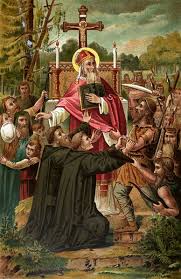 In 754 at the age of eighty, after forty years as a missionary, Boniface set out for Frisia again along the Rhine with fifty-two men: priests, monks, deacons, novices, servants and ten soldiers, desiring to complete the conversion of the Frieslanders. In Frisian territory, he arranged a meeting of converts near the Zuidersee, intending to administer confirmation to them. But just before they arrived, Boniface’s camp at Dokkum was overrun by a hostile force. They slaughtered him and his many companions.
Buried at Fulda
Boniface’s body was taken to Fulda. Although he had enlisted many English men – Saints Lull and Willibald – and women – Saints Walburga and Lioba – to work with him as missionaries, he is much better remembered in Germany than among his fellow countrymen. Many of his letters written in Latin still survive.
******************************
Memorable Saying for Today
“There is no success without sacrifice.
If you succeed without sacrifice it is because someone has suffered before you.
If you sacrifice without success it is because someone will succeed after you.”
~ Adoniram Judson ~
******************************