















Mass Readings
Catholic Ireland
Liturgical Readings for : Saturday, 6th June, 2026Léachtaí Gaeilge
Next Sunday's Readings
Saturday of the Ninth Week of Ordinary Time, Year 2
Saints of the Day: 6 June;
1. St Jarlath, Bishop
C/f A short life of be this saint can be found below todays’ Readings and Reflection.
2. St Norbert, Bishop
C/f A short life of be these saints can be found below todays’ Readings and Reflection.
FIRST READING
A reading from the second letter of St Paul to Timothy 4: 1-8
Make the preaching of the Good News your life’s work, in thorough-going service.
 Before God and before Christ Jesus who is to be judge of the living and the dead, I put this duty to you, in the name of his Appearing and of his kingdom: proclaim the message and, welcome or unwelcome, insist on it. Refute falsehood, correct error, call to obedience – but do all with patience and with the intention of teaching. The time is sure to come when, far from being content with sound teaching, people will be avid for the latest novelty and collect themselves a whole series of teachers according to their own tastes; and then, instead of listening to the truth, they will turn to myths. Be careful always to choose the right course; be brave under trials; make the preaching of the Good News your life’s work, in thoroughgoing service.
As for me, my life is already being poured away as a libation, and the time has come for me to be gone. I have fought the good fight to the end; I have run the race to the finish; I have kept the faith; all there is to come now is the crown of righteousness reserved for me, which the Lord, the righteous judge, will give to me on that Day; and not only to me but to all those who have longed for his Appearing.
The Word of the Lord Thanks be to God.
Responsorial Psalm Ps 70: 8-9. 14-17. 22. R/ .v 15
Response My lips will tell of your justice, O Lord.
1. My lips are filled with your praise, with your glory all the day long.
Do not reject me now that I am old; when my strength fails do not forsake me. Response
2. But as for me, I will always hope and praise you more and more.
My lips will tell of your justice and day by day of your help
(though I can never tell it all). Response
3. I will declare the Lord’s mighty deeds proclaiming your justice, yours alone.
O God, you have taught me from my youth and I proclaim your wonders still. Response
4. So I will give thanks on the lyre for your faithful love, my God.
To you will I sing with the harp to you, the Holy One of Israel. Response
Gospel Acclamation Lk 8: 15
Alleluia, alleluia!
Blessed are those who; with a noble and generous heart, take the word of God
to themselves and yield a harvest through their perseverance.
Alleluia!
Or Mt 5: 3
Alleluia, alleluia!
How happy are the poor in spirit; theirs is the kingdom of heaven.
Alleluia!
GOSPEL
The Lord be with you And with your spirit.
A reading from the Gospel according to Mark 12: 38-44
This poor widow has put more in than all of them.
In his teaching Jesus said,
‘Beware of the scribes who like to walk about in long robes, to be greeted obsequiously in the market squares, to take the front seats in the synagogues and the places of honour at banquets;
these are the men who swallow the property of widows, while making a show of lengthy prayers. The more severe will be the sentence they receive.‘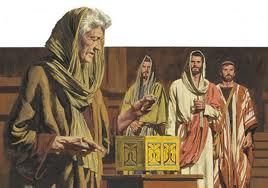
He sat down opposite the treasury and watched the people putting money into the treasury, and many of the rich put in a great deal. A poor widow came and put in two small coins, the equivalent of a penny. Then he called his disciples and said to them,
‘I tell you solemnly, this poor widow has put more in than all who have contributed to the treasury; for they have all put in money they had over, but she from the little she had has put in everything she possessed, all she had to live on.’
The Gospel of the Lord Praise to you, Lord Jesus Christ.
********************
Gospel Reflection Saturday, Ninth Week in Ordinary Time Mark 12:38-44
There is a striking contrast in today’s gospel reading between the ‘scribes’ whom Jesus describes as ‘men who swallow the property of widows’ and the widow whom Jesus holds up as an example of total self-giving to God. She is described as a ‘poor widow’. Perhaps she is one of those widows whose property has been swallowed up by the scribes, the recognized experts in the Jewish Law.
Yet, this widow gives generously to the Temple treasury, believing that in doing so she is giving to God. She gave everything she possessed to God. She exemplifies what Jesus calls the first commandment, to love God with all one’s heart, soul, strength and mind. She fulfils the essence of the Law, whereas the so-called experts in the Law, the scribes, undermine its core value by taking advantage of the most vulnerable. Knowledge does not always lead to virtue. To know the good does not automatically lead to doing the good.
The widow understood the heart of the Jewish Law without having studied it. Jesus holds her up as an example to his disciples. This woman, who would have gone unnoticed in the culture, was noticed by Jesus and he wanted others to notice her. Jesus may have recognized something of himself in this widow. The woman gave everything she possessed to God. As Jesus stood in the Temple of Jerusalem shortly before his passion and death, he would soon give everything he possessed, his very life, to God and to humanity. The widow brings home to us that sometimes the smallest of actions can have something of that same self-giving that Jesus displayed on the cross.
_____________________________
The scripture readings are taken from The Jerusalem Bible, published by Darton, Longman and Todd Ltd and used with the permission of the publishers. http://dltbooks.com/The Gospel reflection comes from WEEKDAY REFLECTIONS : The Word of God is Living and Active by Martin Hogan and published by Messenger Publications c/f www.messenger.ie/bookshop/_
**********************************
Saints of the Day: 6 June; 1. St Jarlath, Bishop
Very little is known of St Jarlath. His first foundation was in Clonfush near Tuam. Later he founded a monastery in Tuam. He is said to have taught Brendan of Clonfert and Colman of Cloyne. Jarlath is the abbot-bishop associated with the archdiocese of Tuam that includes parts of the counties of Mayo, Galway and Roscommon.
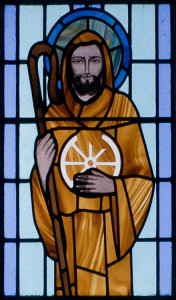 Patrick Duffy looks at what is known about him.
From a Wealthy Family?
Not much is known about the life of Jarlath (Irish Iarfhlaith). He became a disciple of St Enda. The monasteries he founded, first at Cluain ois and Later at Tuam were renowned for their scholarship and learning.
However, Jarlath is regarded as the founder and patron saint of the archdiocese of Tuam in Galway, Ireland. From the second syllable of his name, fhlaith, meaning “lord”, it could be taken that he came from a wealthy family; the meaning of the first syllable is unknown.
Cloonfush and Reputation
Jarlath is said to have studied under Benen (Benignus), a disciple of St Patrick, and under St Enda at Aran Isalnd. The Féilire of Aengus tells us that he was noted for his mortification, fasting, and prayer. He own first monastic foundation was at Cloonfush, some miles east of Tuam. Among his disciples there were Brendan of Clonfert and Colman of Cloyne.
While Jarlath was travelling in his chariot west from Cloonfush, the wheel of the chariot broke. A prophecy of St Brendan of Clonfert had foretold that this place where the wheel of the chariot would break would be the place where he would meet death. So Jarlath decided to found another monastic community here. From this incident, the chariot wheel has become the symbol of the town of Tuam.
The diocese was established by the twelfth-century synods of Rathbreasail and Kells, and subsequently became an archdiocese absorbing into it two other medieval dioceses: Annaghdown and Mayo.
Death and Feast
Jarlath died around 550. His feast is on 6th June.
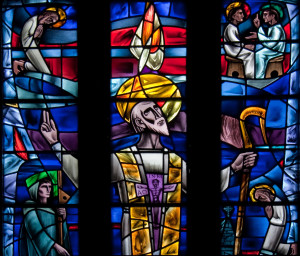
St Jarlath’s Window, Tuam Cathedral
******************************
Memorable Sayings for Today
Prayer is reaching out and after the unseen;
fasting, letting go of all that is seen and temporal.
They confirm our resolution that we are ready to sacrifice anything, even ourselves,
to attain what we seek for the kingdom of God.”
~ author unknown ~
******************************
Saints of the Day: 6 June; 2. St Norbert, Bishop
Norbert was Born in the Rhineland (Germany) about 1080; died at Magdeburg on this day in 1134. A cleric in minor orders, he converted from a comfortable life in 1115, was ordained to the presbyterate, and took up a life of poverty. Founded a community of canons at Prémontré (France), austere in discipline and active in pastoral ministry. Later, as archbishop of Magdeburg, he resisted the alienation of Church property. Noted for his zealous reform of clerical life and for the example of his attachment to the values of the gospel.
 The image (left) is of a commemorative postage stamp depicting St Norbert, who was the founder of the canons of Prémontré, and an indefatigable campaigner against heresy, schism and corruption in the Church.
Patrick Duffy traces St Norbert’s life.
Youth and Conversion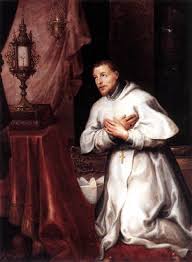
Born 1080 at Xanten in Lorraine, France, on the east bank of the Rhine, Norbert belonged to a noble family related to the Emperor, and worked at the Emperor’s court. Although he became a subdeacon and was canon at 30, he lived quite a worldly and pleasure-filled life until a violent thunderstorm led to his conversion. Influenced by the Benedictine monks of Siegburg, he renounced wealth for poverty, and was ordained a priest in 1115.
Enthusiastic Reformer
The enthusiasm of Norbert’s reforming spirit did not endear him to the clergy of Xanten, who denounced him. However, he travelled widely as an itinerant preacher and was encouraged in this by Pope Gelasius II (1119-20) who was then in Languedoc. He was soon requested by the Bishop of Cambrai to go and combat heresies in the Low Countries where the sacred species had been stolen and profaned. Because of this, Norbert as a saint has been proclaimed the Apostle of Antwerp, and the feast of his triumph over the sacramentarian heresy is celebrated in the archdiocese of Brussels-Mechelen on 11th July.
Foundation at Prémontré
A chance meeting with the young priest Hugh of Fosse, then in the service of Bishop Burchard of Cambray, and appointed to nurse Norbert while convalescing from illness, led to the first foundation of the Norbertine Order in the valley of Prémontré near Laon in Northern France. Here Norbert, Hugh and a few monks lived at first in huts of wood and clay.
Forty Companions Join
Within a few months 40 companions joined them and on Christmas Day 1121, they made profession of vows, choosing a very austere regime of according to a rule of St Augustine. This was the beginning of the Canons of Prémontré of which Hugh became the first abbot. Norbert was in close contact with and was influenced by the Cistercian founder, St Bernard. His own monks had a great influence on the reform of the conventual clergy in France and Germany. He also founded a third order of Norbertines for lay people.
Archbishop of Magdeburg
In 1126 while he was at the Diet of the Holy Empire at Speyer, Germany, the citizens of Magdeburg disagreed on the election of a new archbishop. In the end they elected Norbert by a unanimous vote. This gave him more influence in the cause of reform in the Church at large. Church property that had been given over to families was restored to the Church. And the example of his monks, some of whom he appointed to posts in the archdiocese, promoted the celibacy of the clergy.
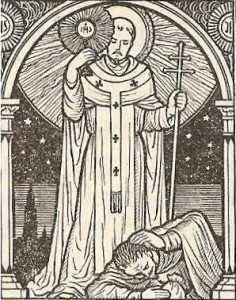 To Italy to Defend Pope Innocent II
With St Bernard, Norbert persuaded the Emperor Lothair II to resist schism in the papacy and to champion the cause of Innocent II as legitimate pope. To this end he joined the emperor in marching to Italy against Pietro di Leone who had installed himself in Rome as an antipope, calling himself Anacletus II. Norbert himself attempted to win Pietro over by persuasion.
Dies at Magdeburg
After these strenuous efforts, he returned to Magdeburg a sick man and died there in 1134. His tomb became famous by the number of miracles performed there. He was canonised by Pope Gregory XIII in 1582. His relics were transferred to the Premonstratensian abbey in Strahov, Bohemia in 1627.
Norbertine Canons in Ireland – sad ending
The Norbertine Canons had one house in Ireland – the Abbey of the Most Holy Trinity and St Norbert – at Kilnacrott, Ballyjamesduff, Co Cavan.
(The last public Mass by a Norbertine priest in Ireland was celebrated on Sun. Sept, 25th, 2016. As of that date all public ministry by the Norbertines on the island of Ireland ceased due to their tragic failure in their policy of Child Safeguarding practices. )
******************************
Memorable Note for Today
(The 4 Rs of Forgiveness)
1. Responsibility: Accept what has happened and show yourself compassion.
2.Remorse: Use guilt and remorse as a gateway to positive behaviour change.
3.Restoration: Make amends with whomever you’re forgiving, even if it’s yourself.
4. Renewal: Learn from the experience and grow as a person.
******************************